

Affiliate marketing is one of the most legitimate and scalable ways to earn online income—and the numbers prove it.
Research shows 74% of brands increased their affiliate investment in 2025 due to rising costs in other marketing channels, and the global affiliate marketing industry as a whole is projected to reach $31.7 billion by 2031.
But where real money flows, fraud follows…
Digital ad fraud costs businesses an estimated $84 billion globally in 2023—and affiliate marketing is one of its most targeted channels. So whether you're a vendor developing your first offer or a super affiliate running a six-figure campaign, the landscape is riddled with programs sophisticated enough to steal your commissions, drain your ad budget, and disappear without a trace. But fear not—we’ve created this article to help. Because affiliate protection isn't a nice-to-have anymore; it's a core business discipline.
We’ve got tips to help affiliates spot fraudulent programs and help brands protect their offers from the affiliate fraudsters quietly siphoning their revenue.
You'll also find real documented case studies, a tool comparison table, and actionable steps that go well beyond what you'll find anywhere else.
So let’s start at the top:
What Are Affiliate Marketing Scams? (And is Affiliate Marketing Legit?)
Before we dive into prevention, it helps to draw a sharp line between what affiliate marketing is and what it isn't.
Legitimate affiliate marketing is a performance-based partnership: an affiliate promotes a product or service using a unique tracking link; when someone makes a purchase using that link, the affiliate earns a commission. It's transparent, contractual, and—when done right—genuinely profitable for everyone involved.
Affiliate marketing scams are deceptive schemes that either:
1. Target affiliates—tricking individuals into joining fake or predatory programs that steal their time, money, or personal data.
2. Target merchants—fraudulent affiliates who fake clicks, leads, or sales to collect commissions they didn’t legitimately earn.
So is affiliate marketing a scam?
No. Absolutely not—it's a $31.7 billion industry backed by major brands from Amazon to Shopify. But like any high-value ecosystem, it attracts marketing fraud—and understanding the difference between the legitimate model and its many imitations is the first line of defense.
So what is affiliate fraud, exactly? Well, it’s any deliberate deception that distorts the performance-based relationship at the heart of affiliate marketing—whether that means fake traffic, manufactured leads, stolen commissions, or fraudulent program operators who never intend to pay out.
8 Common Affiliate Marketing Scams That Target Affiliates

If you're an affiliate marketer evaluating different programs to join, these are some of the most common types of scams to look out for:
1. Pay-to-Join Schemes
Legitimate affiliate programs are always free to join.
If a program requires an upfront "registration fee," "membership access fee," or a mandatory product purchase before you can start promoting, that's a critical red flag. You should never pay for the ‘privilege’ of sending someone else traffic.
This tactic is especially common in pseudo-MLM setups, where the "product" is often the affiliate program itself—meaning you're really just paying to recruit the next person who pays to join.
2. Unrealistic Income Promises & Get-Rich-Quick Claims
"Earn $10,000 your first month—no experience needed!”
Anyone who has built a real affiliate business knows this is a fantasy. Genuine affiliate income requires strategy, audience development, content creation, and consistent optimization. Success in affiliate marketing takes time.
Programs that lead with outlandish earnings claims are almost always designed to get your buy-in (and your data), not to pay you out.
Before joining any program, look for income disclosure statements—if they don't exist, or if the "average earnings" figures are conveniently absent, walk away.
3. Pyramid Schemes & Recruitment-First Structures
If a program's primary income mechanism rewards you for “recruiting new affiliates”— rather than selling actual products to real customers—you’re looking at a pyramid structure.
The Federal Trade Commission (FTC) has a clear line here: legitimate multi-level marketing compensates primarily for retail sales, not recruitment. If the math only works when you bring others in, the product is the pitch—not a real product at all.
4. Fake or Counterfeit Products Designed to Steal Your Data
Some fraudulent programs list high-demand or luxury goods—like electronics, software, or supplements—that either don't exist at all, or are counterfeit.
The goal isn't to sell; it's to collect buyers’ payment data and personal information through a convincing-looking checkout. As an affiliate, your reputation—and your audience's trust—is tied to what you promote. If the product is fake, so is your commission.
5. Cookie Stuffing That Steals Your Commission
Cookie stuffing—when a malicious publisher plants multiple tracking cookies on a user’s browser without their knowledge or consent—is usually a merchant's problem (we'll cover that shortly), but it can also hurt affiliates as well.
In competitive niches, unscrupulous competitors can drop their own tracking cookies on users who clicked your link—effectively stealing your commission attribution. This is especially prevalent in high-payout niches like finance and software.
6. Vague or Missing Terms & Conditions
No commission rate. No payout schedule. No minimum threshold. No cookie duration. NO GO.
A legitimate affiliate program publishes clear, specific terms. Vague or missing terms aren't just a professionalism problem—they're a setup.
Without documented terms, a program can change your commission rate, reverse attributions, or even not pay you at all, with no contractual basis to protect you or challenge them.
7. Social Media "Clone" Accounts & Fake Brand Recruiters
Fraudsters increasingly impersonate well-known brands on Instagram, TikTok, and Facebook, posing as official “affiliate program recruiters”.
They usually offer inflated commissions for promoting fake storefronts or counterfeit goods—sometimes even directing traffic to convincing clone sites.
So always verify affiliate program access through official brand websites, not social DMs.
8. AI-Generated "Guru" Programs & Deepfake Testimonials
This one’s a somewhat newer threat: AI-generated authority figures.
Deep-fake testimonials, fabricated case studies, synthetic "income proof" screenshots, and AI-written review content now make fraudulent programs look polished and credible.
If a program's entire credibility rests on social proof that feels slightly too perfect, it probably is. Always verify the faces, verify the usernames, and cross-reference the claims to be sure.
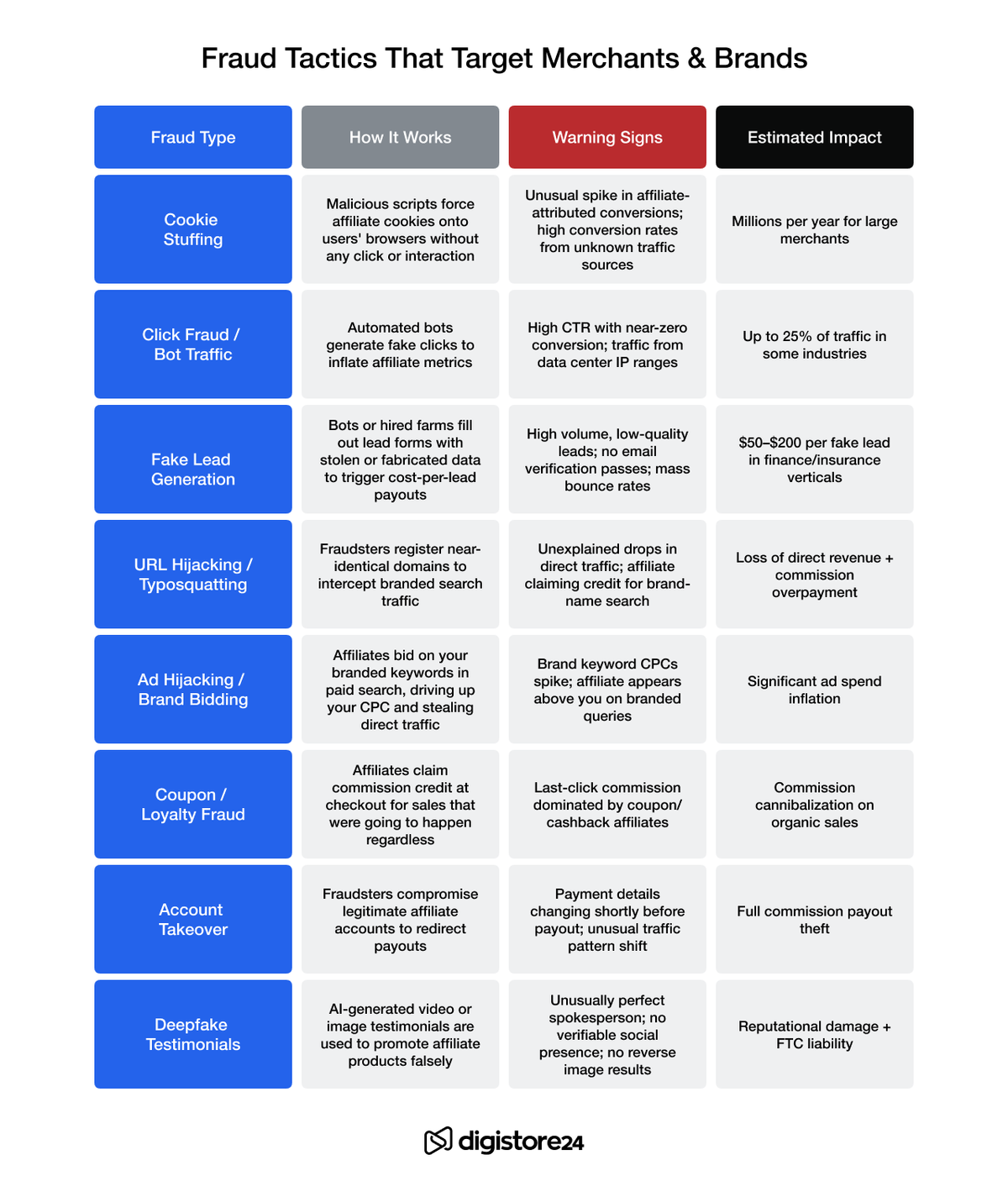
8 Affiliate Fraud Tactics That Target Merchants & Brands
If you run an affiliate program, knowing how to detect affiliate fraud—and how to prevent affiliate abuse before it scales—starts with understanding each method in detail.
These are some of the tactics affiliate fraudsters use to drain your commissions budget without generating a single genuine sale:
How to Avoid Affiliate Marketing Scams as an Affiliate Marketer: 6 Vetting Steps

Familiarizing yourself with the different types of scams is the first line of protection.
Use this practical vetting process to start protecting yourself before you invest any time and traffic into a new program.
Step 1: Start with Vetted Marketplaces; Only Join Programs on Trusted Affiliate Marketplaces
The single most effective way to avoid fraudulent programs is to work with ecosystems that vet products before they appear.
Established and legitimate affiliate platforms (like Digistore24) maintain review processes that screen offers for legitimacy, require clear refund policies, and maintain track records of paying affiliates on time.
Digistore24, for example, publishes transparent refund and cancellation data for every product on its marketplace—so you can evaluate a product's real performance before committing any promotional efforts.With 8,500+ rigorously reviewed offers across 44 niches, it removes most of the manual vetting work that lone affiliates would otherwise need to do themselves.
Step 2: Search for Independent Affiliate Reviews Before You Sign Up
Before signing up for any program, search: [Program Name] + "scam", [Program Name] + "payout issues", and [Program Name] + "review".
Also check Reddit (r/affiliatemarketing is particularly candid), Trustpilot, and LinkedIn.
Affiliate reviews and affiliate marketing reviews posted by real practitioners are far more reliable signals than anything on the program's own website. Look for consistent patterns—one negative review might be an anomaly, but ten complaints about withheld commissions are a pattern.
Step 3: Test Customer Support Before You Commit
Contact the program's support team with a specific question before joining.
Legitimate programs provide timely, accurate, human responses. If you get a canned auto-reply with zero substance—or no reply at all—that instantly tells you everything about how commission disputes will be handled later on.
Step 4: Read the Terms and Conditions (Yes, All of Them)
Confirm the following before joining any program:
- Commission Rate & Structure — Is it a flat fee, percentage, or tiered?
- Cookie Duration — How long does the attribution window last?
- Payout Schedule — Weekly, monthly, net-30, net-60?
- Minimum Payout Threshold — Can you actually reach it?
- Reversal Policies — Under what circumstances can commissions be clawed back?
- Termination Clauses — Can they cancel your account without paying out pending commissions?
If any of these are absent or vague, ask for clarification in writing. If they can't or won't provide it, well, that’s your answer right there.
Step 5: Verify the Brand Has a Real Business Behind It
Check for the following: - A physical business address - Named team members with verifiable LinkedIn profiles - A history of media coverage or press releases - A company registration you can look up. Scam operations often have none of these. A WHOIS domain lookup (whois.domaintools.com) can also tell you when a domain was registered—programs with domains less than six months old deserve extra scrutiny.
Step 6: Monitor Your Attribution Data
Once you're live with a program, monitor your traffic vs. commission data closely.
If you're driving consistent, quality traffic but seeing near-zero conversions, or if your attributed sales suddenly drop with no explanation, investigate.
Use UTM parameters and your own analytics alongside the program's dashboard to catch discrepancies early.
Brands: How to Protect Your Affiliate Program from Fraud
If you're running an affiliate program, fraud isn't a hypothetical—industry research suggests 1 in 4 traffic sources in affiliate channels may involve some form of fraudulent activity.
So understanding how to prevent affiliate fraud in marketing campaigns is a fundamental part of running a profitable program.
Here's how to build a program that can’t be easily exploited:
Vet Every Affiliate Before Approval
Don't auto-approve.
Review each affiliate application manually (or using screening tools).
Look for: - A real website or social presence with genuine content and audience - A coherent promotional strategy aligned with your product, - A contact method that verifies identity Bulk-approving everyone who applies is an open invitation to fraud.
Build a Strong Tracking & Attribution Infrastructure
Use affiliate software that supports:
- Sub-ID / Parameter Tracking — So you can trace every click and conversion to its exact source.
- IP & Device Fingerprinting — To flag suspicious traffic patterns.
- Conversion Validation — So commissions only fire on real, verified transactions.
Set Up Real-Time Affiliate Fraud Monitoring
Ongoing affiliate fraud monitoring is the key to catching problems before they become budget disasters.
Affiliate fraud protection at the program level means having live visibility into traffic quality, conversion patterns, and affiliate behavior—not just reviewing reports after the fact.
The following tools are purpose-built for affiliate fraud detection and prevention, combining real-time affiliate fraud prevention with deep reporting capabilities. They represent the best affiliate fraud detection software available in 2026:
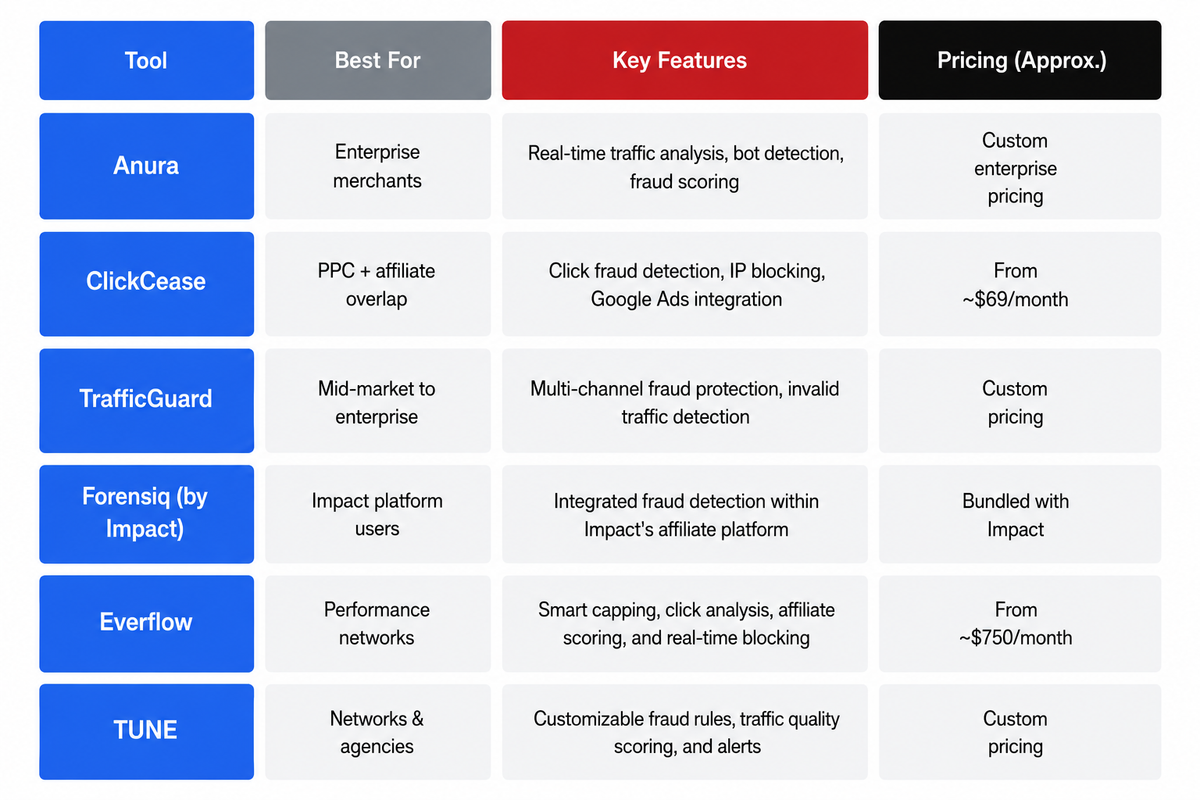
For smaller programs not yet ready for enterprise tooling, Google Analytics 4's anomaly detection—combined with manual commission reviews and strict affiliate approval processes—can also provide meaningful baseline protection.
When evaluating tools to detect affiliate marketing fraud, prioritize platforms that offer real-time blocking (not just retroactive reporting), sub-affiliate-level traffic visibility, and integrations with your existing affiliate network or tracking stack.
The ability to detect affiliate fraud at the click or impression level—rather than discovering it at payout time—is what separates reactive damage control from genuine affiliate marketing fraud detection.
Use Contractual and Structural Safeguards to Prevent Affiliate Fraud
A well-drafted agreement, combined with consistent enforcement, is the most solid way to prevent affiliate fraud—and prevent affiliate abuse long-term.
Here’s where to start:
- Hold periods: Delay commission payouts by 30–60 days to allow for refund and chargeback resolution.
- Clawback clauses: Reserve the right to reverse fraudulent commissions and specify the criteria clearly.
- Prohibited traffic sources: Explicitly list tactics you won't pay for (brand bidding, toolbar traffic, incentivized clicks, etc.) in your affiliate agreement.
- Commission caps: Set maximum daily or monthly commission thresholds per affiliate at the beginning, when you're still establishing trust.
Consider a Merchant-of-Record Platform for Built-In Fraud Protection
One of the most underrated fraud-prevention tactics for smaller brands is to operate through a merchant-of-record platform, rather than managing payments yourself.
When a platform like Digistore24 acts as the seller of record, it processes all payments, manages tax compliance, handles chargebacks, and applies fraud-detection logic developed from years of transaction data.
That aggregated fraud intelligence is simply not available to a brand running a standalone program—and it shifts significant liability away from you.
Real-World Affiliate Fraud Case Studies

But all the facts and theories in the world still won’t hit like a real-world example.So here are three documented cases that show the full spectrum of affiliate fraud and its consequences.
Case Study 1: Shawn Hogan & eBay — The $35 Million Cookie Stuffing Scheme
Between 2006 and 2013, an affiliate named Shawn Hogan—who was, at the time, eBay's largest affiliate—used hidden iFrames embedded in software distributed through his site to force eBay's tracking cookies onto millions of users' browsers without any interaction. The result? eBay paid out tens of millions in commissions for sales that would have happened organically.
Combined with co-conspirator Brian Dunning (eBay's second-biggest affiliate), the two were paid a total of $35 million in fraudulent commissions—Hogan's share alone was $28 million.
Both were charged with wire fraud.
Hogan was sentenced to five months in federal prison and fined $25,000; Dunning received 15 months. This case remains the most cited example of affiliate cookie stuffing at scale—and a stark reminder that even the highest-earning affiliates can be operating fraud you can't see.
Case Study 2: Uber's $100 Million Ad Fraud Discovery
In 2017, Uber's internal team began auditing its performance marketing spend and found that the vast majority of its attributed mobile installs came from ad networks engaging in fraudulent attribution—installing tracking SDKs that falsely credited clicks and conversions.
Uber sued several ad networks and ultimately settled cases totalling over $100 million combined. The company slashed its performance marketing budget dramatically and found its core metrics barely moved—confirming much of what they'd been paying for was fraudulent.
For affiliate managers: if dramatically cutting a traffic source has no impact on real outcomes, fraud is a very plausible explanation.
Case Study 3: The FTC vs. LeadClick Media — $6.1 Million Judgment
In a case prosecuted by the Federal Trade Commission, LeadClick Media (an affiliate network operating under CoreLogic) was found liable for deceptive advertising practices run by affiliates on its network—specifically, fake news sites used to promote weight-loss products.
The key precedent: the FTC ruled the network was liable, not just the individual affiliates. And the court ordered LeadClick to pay out $11.9 million in ill-gotten gains.
The key takeaway for vendors and networks? You cannot outsource liability to your affiliates—what your affiliates do with your brand and tracking links is your responsibility.
Is High Ticket Affiliate Marketing Legit?

High ticket affiliate marketing—promoting products or services with commissions of $500, $1,000, or more per sale—is entirely legitimate.
It exists mostly across software (SaaS tools with $1,000+ ARR), financial services, luxury goods, B2B products, and online education.
But…The higher the commission, the more attractive the target is to fraudsters—and the more aggressively some programs market themselves with lifestyle imagery and income promises to recruit affiliates.
So the core vetting principles stay the same:
- Verify the product is real and in genuine demand - Confirm the program has a documented payout history - Read the terms carefully - Start with lower-stakes traffic before scaling. What ‘high ticket’ should mean is that you're promoting genuinely valuable, premium products to buyers who can afford them—not that you're chasing inflated commissions on questionable offers.
Most legitimate high-ticket programs you'll find on vetted platforms include coaching and mastermind programs, enterprise SaaS tools, financial education products, and specialist B2B services.
The commission is high because the product price is high and the conversion requires real persuasion, not because someone is dangling bait.
How to Report Affiliate Marketing Scams
If you've been defrauded—or suspect a program is operating illegally—reporting is both your right and (if others are being harmed) arguably your responsibility.
So here's where to go:
For Affiliates
- FTC ReportFraud.ftc.gov — File a complaint with the Federal Trade Commission. The FTC investigates deceptive business practices, pyramid schemes, and misleading income claims. Your report will contribute to investigations even if you don't see direct action.
- IC3.gov — The FBI's Internet Crime Complaint Center handles internet fraud, including wire fraud in affiliate contexts, like the Hogan/eBay case, for example.
- BBB Scam Tracker — Report scam programs to warn other affiliates. This is publicly visible and frequently referenced by people vetting programs.
- The/Your Affiliate Network — If a fraudulent program is operating on a legitimate network, like Amazon Associates or Digistore24, contact their compliance team. Reputable networks take this seriously and will investigate and delist bad actors.
For Merchants
- Your Legal Counsel — Affiliate fraud, particularly cookie stuffing and attribution manipulation, can constitute wire fraud under federal law. Document everything.
- The/Your Affiliate Network — Most major platforms have fraud reporting channels. Escalate with data: traffic anomaly reports, conversion irregularities, and any evidence of the specific tactic used.
- FTC Business Center — If the fraud involves deceptive advertising on your brand, the FTC's business guidance resources outline your reporting and remediation options.
- Your Payment Processor — For systematic chargeback fraud, notify your payment processor and document the pattern. High chargeback rates often precede processor interventions that can protect your account.
FTC Disclosure Compliance for Affiliates
Also worth noting: the FTC doesn't just investigate fraud—it also enforces disclosure rules for legitimate affiliates.
If you earn commissions from promoting a product, you are legally required to disclose that material connection clearly and conspicuously. The FTC's Endorsement Guides were updated in 2023 and apply to social media posts, YouTube videos, blog content, and email. Non-compliance can result in civil penalties—and it's a separate issue from whether the program you're promoting is itself legitimate.
Affiliate Marketing Is a Legitimate & Lucrative Business—But Only If You're Working With the Right People
Affiliate marketing works.
Thousands of individuals build sustainable, significant income through it every year—and thousands of vendors grow their businesses through affiliate partnerships that pay for genuine performance.
The model itself is sound.
So is affiliate marketing legit? Absolutely. The question is only whether the specific program, platform, or partner you're working with is.
Never assume good faith without doing the research first. The scams are real, the fraud is sophisticated, and the fraudsters are continuously evolving their tactics—from cookie stuffing to AI-generated deepfakes and beyond.
So the most effective protection—for affiliates and vendors alike—is choosing to operate within an ecosystem that’s built around accountability. For affiliates, that means using marketplaces where products are vetted before they appear, where payout histories are visible, and where a compliance team is actively monitoring quality.
For vendors, that means building programs with proper tracking infrastructure, contractual safeguards, fraud monitoring tools, and—ideally—a platform that handles the fraud, chargeback, and compliance layers on your behalf.
And that's exactly what Digistore24 is built to do.
Whether you're an affiliate looking for thousands of verified offers across 44 niches with transparent performance data, or a vendor who wants built-in payment processing, fraud prevention, and done-for-you chargeback management, the infrastructure is already there.
So the moral of this story? Affiliate marketing is legitimate—just make sure the platform you use is too.
Want to launch your new product or affiliate business with an established, fraud-protected platform that does all the heavy-lifting for you?
Sign up for a free Digistore24 account and get started today.
FAQ
Is affiliate marketing a scam?
No. Affiliate marketing is a legitimate, well-established performance marketing model used by thousands of major brands globally, including Amazon, Apple, Shopify, and Adobe.
It's a $31.7 billion industry that’s projected to keep growing. The existence of scams within the affiliate space doesn't make the model itself a scam—just as the existence of investment fraud doesn't make investing a scam. The key is doing due diligence on programs before you join them.
What is affiliate fraud?
Affiliate fraud refers to deceptive tactics used to manipulate affiliate marketing programs—either by fraudulent affiliates exploiting merchant programs (through fake clicks, bot traffic, cookie stuffing, or fake leads), or by fraudulent programs exploiting affiliates (through unpaid commissions, misleading earnings claims, or pay-to-join schemes). Both types cause real financial harm.
What are the biggest red flags when evaluating an affiliate program?
Some of the top red flags include: - Upfront fees to join - Vague or missing terms and conditions - Unrealistic income guarantees - A primary focus on recruitment over product sales - No verifiable business presence - No documented payout history.Any one of these warrants deeper scrutiny—and multiple red flags simultaneously are a strong signal to walk away.
How do I know if an affiliate program is legitimate?
Use vetted platforms with compliance infrastructure, search for independent reviews on Reddit and Trustpilot, verify the company's registration and physical address, test customer support before joining, and read the full terms of service.
Look for documented commission rates, transparent payout schedules, and a product that serves real customer needs.
Can affiliate fraud be automated and detected automatically?
Yes. Modern fraud detection platforms like Anura, TrafficGuard, and Everflow use machine learning models to detect anomalous traffic patterns, bot signatures, and attribution manipulation in real time.
For larger programs, automated affiliate fraud detection isn’t optional—it's essential. Robust affiliate fraud protection requires both automated tooling for scale and human review for edge cases. Manual reviews alone can’t keep pace with bot-driven fraud at scale.
What should I do if an affiliate program doesn't pay me?
Start by reviewing your contract and confirming you've met all payment conditions. Then contact support in writing and request a specific resolution timeline.
If they don't respond or refuse to pay without a valid contractual basis, file a complaint with the affiliate network (if applicable), report to the FTC or IC3, and consider consulting a lawyer if the amounts are significant.
Keep all documentation of your traffic, conversions, and communications.
Is high-ticket affiliate marketing legitimate?
Yes—high ticket affiliate marketing is legitimate when the products being promoted are genuine, high-value offerings, and the program's terms are transparent.
As with any affiliate program, higher commissions attract more fraudulent operators, so due diligence is even more important—verify that the product exists, has real customers, and has a documented commission payout history before investing significant promotional resources.
What is the FTC's position on affiliate marketing?
The FTC considers affiliate marketing legitimate but regulated.
Affiliates must clearly disclose material connections (commissions) to audiences—as per the FTC Endorsement Guides.
Networks and merchants can also face FTC liability for deceptive practices carried out by their affiliates, as the LeadClick/ValueClick case demonstrated. GDPR similarly applies to affiliate data practices in European markets.