

What Is CPA Affiliate Marketing?
CPA affiliate marketing is a performance-based advertising model where an advertiser pays a publisher (affiliate) only when a user completes a specific, predefined action — not just for clicks or impressions. The "CPA" stands for "Cost Per Action" (also called Cost Per Acquisition), and the trigger can range from submitting a lead form to completing a purchase.
The CPA formula is simple:
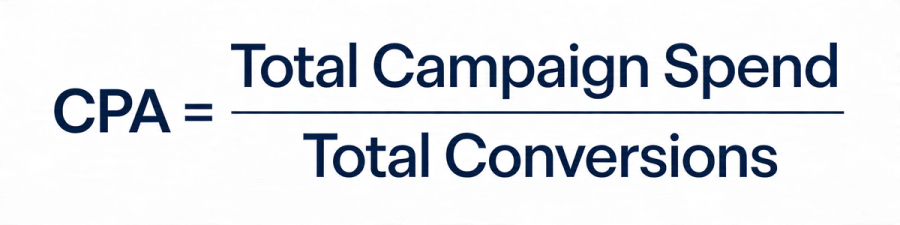
So if a brand pays out $5,000 in commissions and generates 250 conversions, the CPA is $20.
Unlike CPM (Pay-Per-Impression) or CPC (Pay-Per-Click) models, CPA ties every dollar spent directly to a measurable outcome — making it one of the most capital-efficient channels in digital marketing. Affiliate marketing is a $17–18.5 billion global industry in 2025, with 99% of programs using a CPA-based payout structure.
How Does CPA Affiliate Marketing Work?
Three actors drive the CPA ecosystem:
- The Advertiser (Merchant): Defines the conversion event and sets the payout rate. This could be a SaaS company paying $25 per free trial sign-up, a supplement brand paying 70% commission per sale, or an insurance provider paying $80 per completed quote form.
- The Affiliate (Publisher): Promotes the offer via content, paid ads, email, or social media and earns a commission per completed action. Affiliates range from solo bloggers and YouTubers to large media companies running millions of dollars in paid traffic.
- The CPA Network / Marketplace: Connects advertisers with affiliates, manages tracking and attribution, prevents fraud, and handles payouts. The network is the trust layer of the ecosystem — vetting both sides, enforcing offer terms, and ensuring commissions are paid accurately and on time.
The Converion Flow: Click to Payout
- The affiliate selects an offer from a network and receives a unique tracking link.
- A user clicks the link and lands on the advertiser's page.
- The user completes the target action (purchase, sign-up, form submission).
- The network's tracking technology — ideally "server-to-server (S2S) postback" — records and attributes the conversion.
- The advertiser's account is debited, and the affiliate is credited their commission.
- The affiliate is paid on the network's schedule (weekly, bi-weekly, or up to 3× per week on platforms like Digistore24).
S2S postback is the gold standard for attribution because it is unaffected by browser cookie restrictions, iOS privacy changes, or ad blockers — a critical advantage in 2026.
CPA vs. CPC vs. CPM vs. Revenue Share
Understanding how CPA compares to other pricing models helps both advertisers and affiliates pick the right structure for their goals.
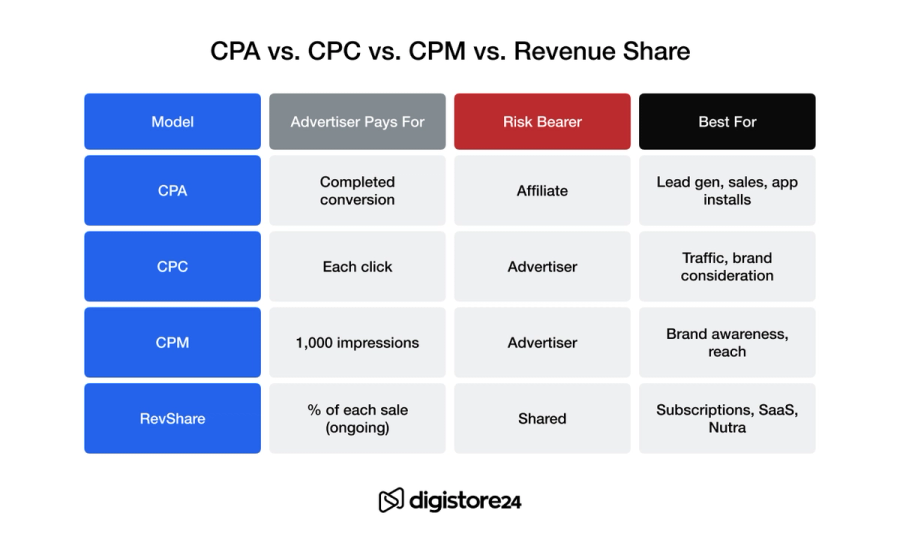
Key takeaway: CPA is the most risk-efficient model for advertisers — payment is only triggered by results. RevShare can outperform CPA over time for subscription products with strong retention, which is why hybrid CPA + RevShare models are gaining traction.
Types of CPA Conversions
CPA is an umbrella term. The most common sub-types are:
- CPL (Cost Per Lead): User submits contact information. Finance affiliates average $60–$250 per qualified lead. CPL is popular with advertisers because it fills a sales pipeline without requiring an immediate purchase decision from the user.
- CPS (Cost Per Sale): User completes a purchase. Health/Nutra offers on Digistore24 can pay 60–75% commission with flat CPA bonuses. CPS tends to attract the highest-quality affiliates because the conversion requirement filters out low-intent traffic.
- CPI (Cost Per Install): User downloads and installs an app — common in mobile gaming and utility apps. Payouts typically range from $0.50 to $3 for casual games, and significantly higher for fintech or subscription apps with strong LTV.
- DOI/SOI (Double/Single Opt-In): User confirms an email subscription. Average CPA: $8–$35. SOI requires just one action; DOI requires a confirmation click, making it a higher-quality but lower-volume lead type.
- CPV (Cost Per View): User watches a video to a qualifying threshold — used in VSL funnel campaigns. Particularly effective for health and personal finance offers where education is part of the conversion journey.
Benefits and Risks of CPA Affiliate Marketing
For Advertisers
- Zero wasted spend: Every dollar paid maps to a defined outcome. There are no impressions that go unseen and no clicks that lead nowhere — only completed actions trigger a payment.
- Predictable CAC: Brands can model profitability before scaling. Companies may see an average $12–$15 return for every $1 invested in affiliate marketing.
- Scalable distribution: Over 81% of brands now leverage affiliate programs for access to diverse traffic sources without building an in-house media team. Rather than hiring and managing a large advertising department, advertisers can tap into an established network of motivated publishers overnight.
- Risk: Affiliate fraud costs the industry an estimated $1.4 billion annually. Robust S2S tracking and affiliate vetting are essential safeguards — not optional extras.
For Affiliates
- Lower barrier to conversion: Lead gen and opt-in actions convert more easily than direct purchases, broadening the pool of viable traffic. An affiliate promoting a free trial offer, for example, faces far less buyer resistance than one selling a $200 product outright.
- No product or fulfilment risk: Affiliates promote; advertisers deliver. Top performers average over $44,000 per month, without ever handling inventory, customer support, or refunds.
- Flexibility: CPA affiliates can work across multiple verticals and networks simultaneously, mixing traffic sources and offers to build resilient, diversified income streams.
- Risk: Offer volatility and rising paid media costs can flip profitable campaigns to a loss quickly — diversifying across offers and traffic channels is essential.
Illustrative Case Study: How a Health Supplement Brand Cut CAC by 38%
To illustrate how this plays out in practice, consider a hypothetical, mid-sized health supplement brand launching a CPA affiliate program on a managed marketplace. Prior to CPA, the brand was running Meta ads in-house at a customer acquisition cost (CAC) of around $52. After listing their offer through an affiliate network — setting a CPA payout of $35 per sale and providing affiliates with professionally produced VSL creatives — they recruited 40 active affiliates within 60 days.
Within 90 days, the blended CAC across all affiliate-driven sales had dropped to approximately $32, a 38% reduction. Because affiliates absorbed the media buying risk, the brand's ad spend became fully variable and directly tied to confirmed sales. Top-performing affiliates were offered a hybrid CPA + RevShare structure on subscription rebills, further improving affiliate motivation and customer lifetime value for the brand.
The lesson: the most successful CPA programs treat affiliates as partners, not just a traffic source — investing in quality creatives, transparent tracking, and performance-based incentives that align both sides of the relationship.
If you're an offer owner, the takeaway is straightforward: list your product on a managed marketplace, set a payout that gives affiliates a genuine reason to prioritize your offer, and equip them with professional creatives from day one. If you're an affiliate, look for offers that already have the infrastructure in place — strong EPC data, low refund rates, and an advertiser who clearly wants you to succeed. Either way, the CPA model rewards preparation. The brands and affiliates who treat their programs as long-term partnerships — rather than short-term transactions — are consistently the ones who scale.
How to Get Started: For Advertisers
Step 1 – Define your conversion event. Choose a single, trackable, high-value action as your CPA trigger: a completed purchase, qualified lead, or app install.
Step 2 – Set a competitive, profitable payout. Use the Maximum Allowable CPA formula:
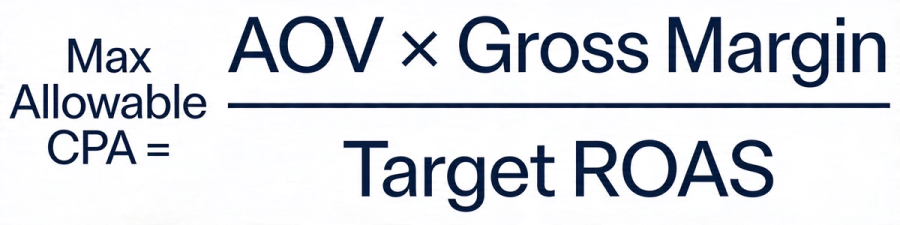
Set your affiliate payout below this ceiling while remaining competitive in your niche. Research what comparable offers in your vertical are paying — affiliates evaluate multiple programs simultaneously, and an uncompetitive payout simply won't attract top publishers.
Step 3 – Choose a marketplace. A well-managed platform handles affiliate recruitment, fraud screening, and payment processing. Digistore24's marketplace offers 8,500+ vetted offers across 44 niches, a built-in network of 60,000+ affiliates, automated VAT and tax handling, and dedicated account managers who personally match advertisers with high-performing affiliates.
Step 4 – Implement S2S tracking and optimize your funnel. Deploy server-to-server postback from day one and A/B test your landing page with tools like Digistore24's Conversion Cockpit, one-click upsells, and customizable order forms — all of which directly improve the conversion rates your affiliates depend on. An offer that converts at 3% instead of 1.5% is, from an affiliate's perspective, twice as valuable — meaning your program will naturally attract better-quality publishers.
Step 5 – Recruit and retain top affiliates. The top 10% of affiliates drive approximately 90% of all affiliate revenue. Offer performance-based payout bumps and provide professional creative assets (email swipes, banners, VSL scripts). Communication matters too — affiliates who feel supported and informed will prioritize your offers over competitors.

How to Get Started: For Affiliates
Step 1 – Choose a niche with high CPA potential. For beginners, Health & Fitness, Business Opportunity, and Personal Development are the top three verticals by volume on major platforms. Finance and insurance niches deliver the highest average payouts per lead, though they typically require more established traffic sources to enter competitively.
Step 2 – Join a reputable CPA network. Evaluate networks on payout speed, offer diversity, S2S tracking support, and transparent refund/chargeback data. These numbers directly determine your actual net earnings per campaign — a 75% commission rate means very little if a product carries a 20% refund rate.
Step 3 – Select offers using EPC as your filter. Earnings Per Click (EPC) normalises payout size and conversion rate into a single comparable metric. On Digistore24's marketplace, EPC, AOV, refund rates, and creative assets are all visible upfront — so you can evaluate offers before committing traffic.
Step 4 – Drive traffic from the right channel. 69% of affiliates use SEO as their primary source. Email marketing delivers high ROI for direct response CPA offers. Paid media (Meta, Google, TikTok, YouTube) enables fast scaling — especially for VSL-based health and Nutra offers.
A key often-overlooked channel: CPA email marketing, which pairs segmented subscriber lists with targeted CPA offers to deliver some of the highest EPCs in the industry with minimal ad spend. Unlike paid traffic, where costs are continuous, a well-maintained email list is an owned asset that generates returns with every send. Affiliates who combine a strong lead magnet strategy (to grow the list) with carefully matched CPA offers (to monetise it) can build highly resilient income streams that aren't subject to platform algorithm changes or rising CPMs.
Step 5 – Track, test, and apply the 80/20 rule. Use sub-IDs to isolate your best-performing traffic sources. 48% of affiliate marketers use dashboards to track and optimize CPA in real time. Roughly 20% of your offers will drive 80% of your revenue — identify them early and scale hard.
Top CPA Affiliate Networks & Marketplaces in 2026
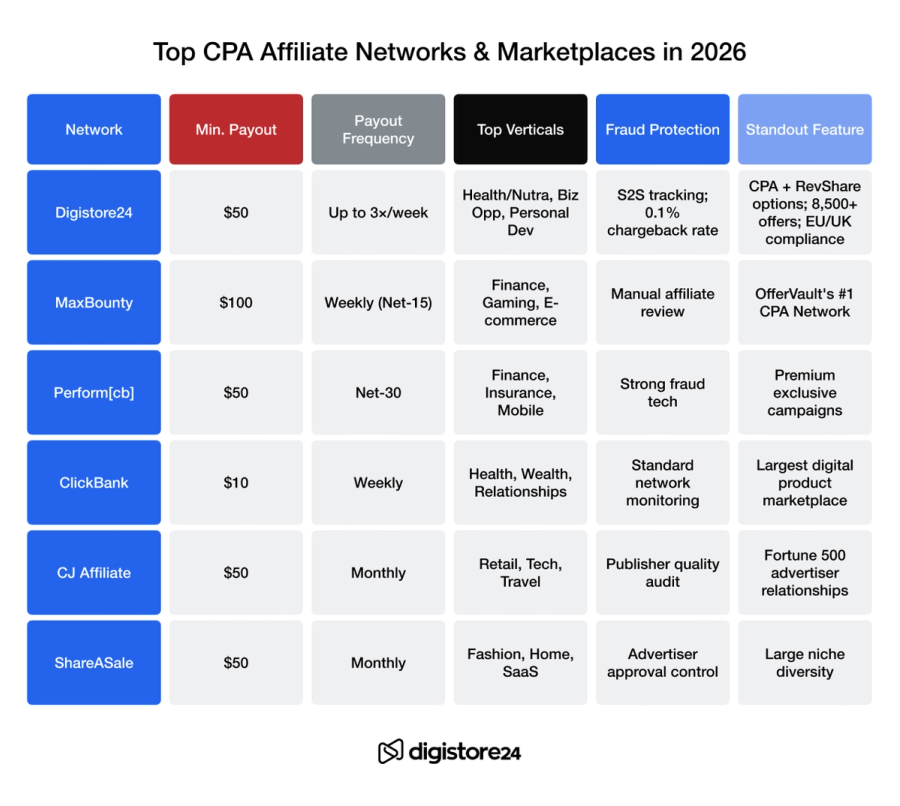
Not all CPA networks are created equal. The right choice depends on your vertical, your role (advertiser or affiliate), your payout expectations, and how much support you need to get started. The table below compares the leading platforms across the metrics that matter most in 2026.
CPA Affiliate Marketing Best Practices
1. Use S2S postback tracking from day one. Browser cookies are unreliable in 2026 due to Safari's ITP, iOS ATT, and Chrome's evolving privacy model. S2S is the only attribution method that survives these changes — and affiliates increasingly expect it as table stakes from any serious program.
2. Test hybrid CPA + RevShare models. For subscription or continuity products, a flat CPA on the front-end plus RevShare on rebills maximises affiliate motivation and advertiser LTV efficiency. Digistore24 is among the first full-service platforms to offer both structures with simple, flexible setup.
3. Invest in fraud prevention. Implement velocity checks, IP/geo filtering, and manual affiliate vetting. Monitor chargeback rates as a proxy for traffic quality — anything above 1% warrants immediate investigation. For high-volume programs, consider dedicated fraud detection tools that flag suspicious patterns in real time before significant budget is exposed.
4. Leverage AI for optimization. 93% of US affiliates already use AI tools for content creation, audience targeting, and campaign scaling. In 2026, AI enables real-time bid optimisation, personalised email hooks at scale, and predictive analytics that identify winning offers before a significant budget is committed. Advertisers can use AI-driven creative testing to iterate on landing pages far faster than manual split-testing alone would allow.
5. Diversify traffic and offers. Relying on a single channel or offer is a business risk. Affiliates who blend SEO, email, and paid media have more resilient income streams. Short-form video and social commerce on TikTok and Instagram are the fastest-growing traffic channels for affiliate marketers right now — but the affiliates who thrive long-term are those who never let any single platform account for more than 50% of their revenue.
6. Keep content and offer lists current. Use only live, active offers with up-to-date creative assets. Burned-out or paused offers waste traffic and erode audience trust — a particular risk when promoting to email lists built over years. A quarterly audit of all active offers is a simple habit that protects both your income and your audience's trust.
Conclusion
CPA affiliate marketing is one of the most aligned performance models in digital commerce: advertisers pay only for outcomes, affiliates are rewarded for results, and well-run platforms provide the infrastructure both sides need to scale. With the global affiliate industry projected to grow from $17–18.5 billion in 2025 to over $31 billion by 2031, the opportunity — for brands and marketers alike — has never been greater.
The businesses winning in 2026 treat their affiliate programs as strategic acquisition channels, investing in offer quality, tracking infrastructure, and genuine affiliate relationships. The affiliates thriving are those pairing niche expertise with data-driven testing and diversified traffic.
Digistore24 gives both sides everything they need to launch, scale, and profit: 8,500+ offers across 44 niches, up to 100% commissions, payouts up to 3× per week, full S2S tracking, automated compliance, and dedicated account managers who act as genuine growth partners.
FAQ
What is CPA affiliate marketing?
CPA affiliate marketing is a performance-based model where affiliates earn a commission every time a referred user completes a specific action — a purchase, sign-up, or lead form. Advertisers only pay when results are delivered.
What is a CPA affiliate network?
A CPA affiliate network is a marketplace connecting advertisers with affiliates. It manages tracking, attribution, fraud prevention, and payouts. Examples include Digistore24, MaxBounty, ClickBank, and CJ Affiliate.
What is a good CPA rate?
It depends on the vertical. Finance affiliates average $60–$250 per lead; e-commerce averages $12–$40. For advertisers, a good CPA is one below your Maximum Allowable CPA (AOV × Gross Margin ÷ Target ROAS).
CPA vs. CPS — what's the difference?
CPS (Cost Per Sale) is a subset of CPA triggered specifically by a completed purchase. Other CPA subtypes include CPL (lead), CPI (install), and DOI (email opt-in).
Is CPA marketing worth it for beginners?
Yes — particularly because CPA conversions like email opt-ins or free trial sign-ups are easier to achieve than direct purchases. Start with one niche, one traffic channel, and one network. Master the basics before diversifying.
How do I track CPA conversions?
Use S2S postback tracking as your primary method — it is privacy-resilient and the most accurate option available. Combine with sub-IDs to segment traffic sources, and use your network's analytics dashboard for campaign-level reporting.
What are the biggest challenges in CPA marketing?
The most common challenges are: driving consistent traffic (cited by 42% of affiliates), low conversion rates (38%), affiliate fraud (23% of merchants), and delayed payouts (28% of affiliates). Choosing the right network, implementing S2S tracking, and selecting a platform with reliable payout schedules addresses most of these.
What metrics should I monitor in CPA marketing?
Track CPA, EPC (Earnings Per Click), conversion rate, AOV, ROAS, and refund/chargeback rate. EPC is the single most useful comparative metric for affiliates — it normalises both payout size and conversion rate across different offers.


