

Imagine earning a commission not just once, but every single month from the same customer you referred — for as long as they remain active. That is the core promise of revenue share (RevShare) affiliate marketing, and it is why an increasing number of experienced affiliates are making it the cornerstone of their long-term income strategy.
The global affiliate marketing industry is valued at over $18.5 billion in 2024 and is projected to reach $31.7 billion by 2031, growing at a compound annual growth rate (CAGR) of roughly 8%. Inside that fast-expanding ecosystem, RevShare stands out as the model best suited for affiliates who want to build compounding, passive income rather than chasing one-time payouts.
This guide explains everything you need to know: what revenue share affiliate marketing is, how it works step by step, how it compares to CPA and other models, which verticals it suits best, and how to maximize your earnings while avoiding the pitfalls that trip up beginners.
What Is Revenue Share (Rev Share) in Affiliate Marketing?
Revenue share affiliate marketing — commonly shortened to RevShare or written as Rev Share — is a performance-based compensation model in which an advertiser pays an affiliate a percentage of the ongoing revenue generated by the customers the affiliate refers, rather than a one-time flat fee.
In this model, the affiliate is treated less like a traffic source and more like a genuine long-term business partner. Instead of receiving a fixed payment for a single "click" or "lead," the affiliate earns a recurring cut of the actual money the business earns from that user — typically for the lifetime of that customer's relationship with the merchant.
A simple example: You refer a customer to a SaaS tool that charges $100/month. The vendor's RevShare rate is 30%. You earn $30 every month the customer remains subscribed. After 12 months, your commission from that single referral totals $360 — far more than most flat-fee alternatives would have paid.
This alignment of interests is what makes RevShare structurally compelling. When affiliates earn more only when the merchant earns more, both parties are motivated to attract and retain high-value, loyal customers — a fundamentally different relationship than transactional CPA, one that rewards quality over volume.

How Revenue Sharing Works: Step by Step
Understanding rev share mechanics helps affiliates evaluate offers more accurately. The process flows like this:
- Attract — The affiliate promotes the vendor's product or service using a unique tracking link embedded in content, ads, email, or social media.
- Convert — A user clicks the link, visits the vendor's platform, and completes a qualifying action (purchase, sign-up, or deposit).
- Track — The vendor's affiliate platform logs the affiliate as the referrer and continues attributing that user's future activity to the affiliate's account.
- Share — The platform calculates the net revenue generated by the referred user, deducts agreed expenses (such as refunds, bonuses, or processing fees), and pays the affiliate their agreed percentage.
- Recur — Payments are repeated — monthly, quarterly, or per billing cycle — for as long as the customer remains active and revenue-generating.
A practical calculation: If a customer referred to an online subscription service generates $200 in monthly net revenue, and the RevShare rate is 40%, the affiliate earns $80 that month. Accumulate 50 such customers, and that becomes $4,000 per month in passive income from a single program — all without acquiring any new traffic.
This compounding dynamic is why RevShare is sometimes described as "building an asset" rather than simply running a campaign. Each referred customer adds to a base that generates income indefinitely, provided the vendor retains them.
RevShare vs. CPA vs. CPL vs. Hybrid: A Side-by-Side Comparison
Most affiliate programs offer one of four main commission structures. Each has specific advantages depending on your traffic type, risk tolerance, and income goals.
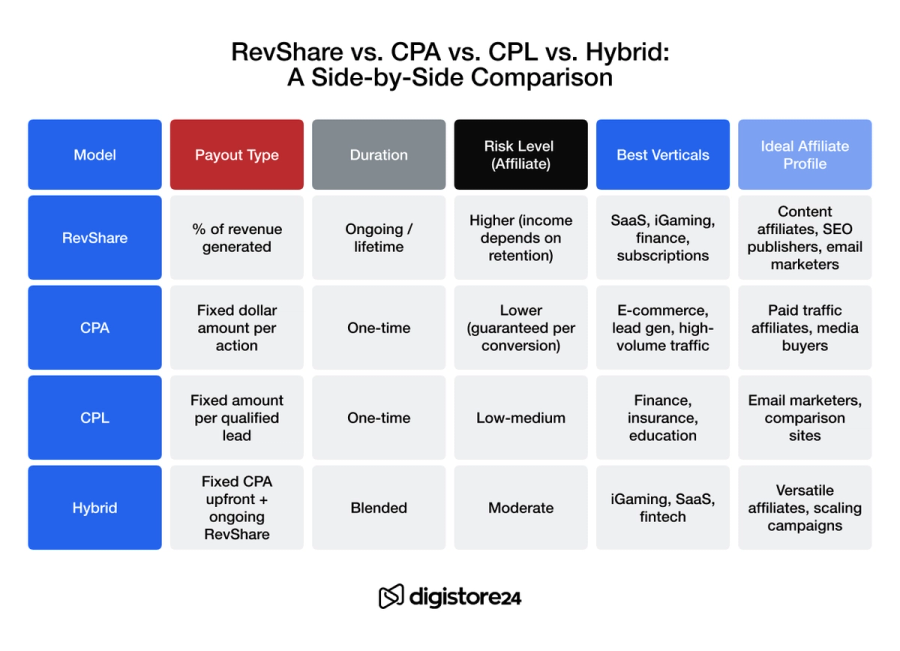
CPA excels when you run paid traffic and need immediate ROI to reinvest in campaigns. RevShare excels when your traffic is organic, your audience is loyal, and you are willing to wait for income to compound over months. Hybrid models — offering a smaller upfront CPA combined with ongoing RevShare — are increasingly popular in iGaming and fintech, where operators want to attract quality affiliates without requiring them to absorb all the retention risk. In 2026, experienced affiliates and operators are increasingly turning to flexible hybrid structures that adapt based on traffic source.
Verticals Where RevShare Works Best
RevShare performs exceptionally well in industries where customers have long lifetime value, predictable recurring spend, or high engagement frequency.
SaaS & Subscriptions
SaaS affiliate programs are among the most consistent sources of RevShare income. Most offer commission percentages between 20% and 30% of recurring revenue, with top-tier affiliates in some programs earning up to 40–60%. Tools like GetResponse offer 40–60% recurring commissions, and beehiiv's partner program pays up to 60% recurring for 12 months. Because SaaS customers often remain subscribed for years, a single referral can pay out for 24–36+ months.
iGaming & Online Gambling
The iGaming vertical is one of the largest and most lucrative environments for RevShare. The global online gambling market reached $107.6 billion in 2026 and is projected to reach $153 billion by 2030. Casino and sportsbook operators typically pay affiliates 25–55% of a player's net revenue for life. Premium programs like N1 Partners offer custom RevShare rates of up to 45%. The trade-off is negative carryover — a significant risk unique to this vertical, discussed in detail below.
Finance & Trading
Forex brokers, crypto exchanges, and fintech platforms pay affiliates a share of trading fees or spread generated by referred traders. An active forex or crypto trader generating consistent volume creates reliable monthly rev share income for the referring affiliate. Finance and insurance affiliates earn the highest commissions on average across CPA structures, but RevShare can compound far beyond that when traders remain active.
E-Commerce & Digital Products
Platforms like Digistore24 offer both CPA and RevShare commission options across 8,500+ vetted offers in 44 niches. RevShare commissions on digital products — including health, personal development, and online marketing offers — routinely reach 60–75%, with some offers paying up to 90%. The combination of high RevShare rates and multiple upsells in a well-structured funnel can significantly increase average order value and total affiliate earnings per referral.
Dating & Membership Communities
Subscription-based dating platforms and membership communities offer strong RevShare potential because retention is often high. Affiliates earn a percentage of monthly subscription fees for as long as referred members remain active, creating reliable recurring income from a single promotional push.

Pros and Cons of RevShare for Affiliates
Advantages of RevShare
- Compounding passive income. Each referred customer adds to your cumulative earnings base. Unlike CPA, where income resets to zero unless you keep acquiring new customers, RevShare creates an income stream that grows the longer your referrals remain active.
- Alignment of interests. Both affiliate and vendor are incentivized to attract high-value, long-term customers — reducing friction and promoting cooperative relationships.
- Scalability without proportional effort. Once you've built a base of referred customers, income continues whether you are creating new content or not.
- Upsell upside. Affiliates often earn a percentage of the full order value, including upsells the customer purchases post-conversion — a significant advantage over flat-fee CPA in high-upsell funnels.
Disadvantages and Risks of RevShare
- Delayed income. RevShare takes time to compound. Affiliates running paid traffic may wait months before accumulated earnings exceed ad spend, making it poorly suited to high-velocity paid acquisition without a hybrid supplement.
- Churn dependency. Your earnings depend entirely on the vendor's ability to retain the customer. Poor product quality or weak onboarding on the vendor's side can collapse your revenue base without any change in your own performance.
- Refunds and chargebacks. In RevShare, the word "share" goes both ways. If a customer requests a refund, the affiliate's commission is typically clawed back.
- Negative carryover (iGaming-specific). In online casino RevShare programs, if players win more than they lose in a given month, net gaming revenue goes negative. Under negative carryover terms, this deficit carries forward into the following month — always verify whether a program applies this before signing up. This is a critical and often misunderstood risk.
Red Flags to Watch For in RevShare Offers
Watch for these warning signs before committing traffic to any RevShare program:
- Opaque net revenue reporting. If the vendor does not provide a transparent breakdown of how net revenue is calculated, walk away. Gross and net revenue can differ by 30–40% in some programs, directly impacting your commission.
- Unreasonably high RevShare percentages. A program offering 90%+ RevShare on a product with high refund potential may be masking poor retention. Sustainable programs balance attractive rates with realistic retention figures.
- No hybrid or CPA option. Reputable programs offer flexibility. A vendor who only offers RevShare may have low confidence in their own customer lifetime value.
- Negative carryover clauses buried in terms. Some programs apply negative carryover at very low thresholds, meaning even a marginally negative month can eat into future earnings.
- No minimum payout guarantee. Programs with no floor on monthly payouts can result in months of zero earnings despite activity.
- No dedicated affiliate support or reporting. Transparent, real-time reporting with segmented data is the minimum standard for a trustworthy RevShare program.
RevShare Earnings Projection: 12-Month Comparison vs. CPA
One of RevShare's most compelling arguments is the long-term income curve — but it requires patience. The table below illustrates a realistic comparison using a SaaS product that pays either a $50 CPA per sale or a 30% RevShare on a $30/month subscription, assuming 20 new sales per month and a 5% monthly churn rate:
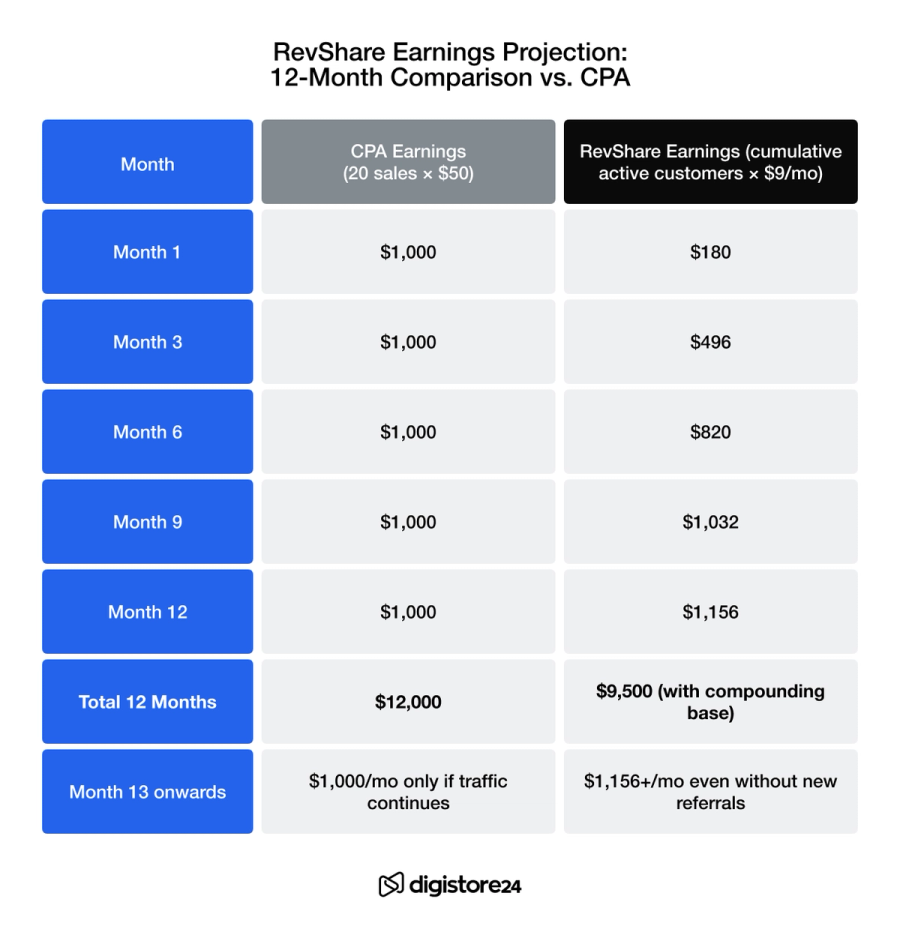
By month 9, RevShare monthly earnings overtake CPA in this scenario — and crucially, the RevShare base continues generating income even if the affiliate stops driving new traffic. For affiliates running SEO-driven content or email campaigns, the RevShare curve is strongly favoured.
This dynamic is consistent with broader industry trends: the Performance Marketing Association's 2025 Industry Study found affiliate marketing spending grew 49.8% from $9.1 billion in 2021 to $13.62 billion in 2024, with a CAGR of 14.42% — twice the pace of the broader e-commerce market — driven partly by the shift toward long-term partnership models like RevShare.
How to Maximize Your RevShare Earnings
Successfully profiting from RevShare requires a strategy beyond simply choosing the highest percentage on offer. These are the principles that separate consistent earners from those who plateau.
- Focus on high-retention offers. Evaluate vendor metrics carefully — look for low refund rates (below 5% is ideal), strong onboarding sequences, and verifiable customer satisfaction data. On Digistore24, you can filter offers by refund rate, conversion rate, and EPC before promoting.
- Evaluate LTV data before committing. Ask the vendor for cohort-level data showing how long customers typically stay active. An offer with 25% RevShare but 18-month average retention can outperform one offering 40% RevShare with 3-month average retention.
- Match traffic source to commission model. Organic traffic from SEO or email lists is well-suited to RevShare because such audiences tend to be higher-intent and more loyal. Paid traffic affiliates should lean toward CPA or hybrid models to protect ROI.
- Diversify across multiple verticals. Concentrating all RevShare income in a single program creates fragility. Spreading referrals across SaaS, digital products, and subscription offers ensures that churn or rate changes in one area don't eliminate your entire revenue base.
- Audit advertiser reporting regularly. Request monthly breakdowns of net revenue calculations and verify that deductions are consistent and contractually stipulated. Affiliates who monitor reporting actively can identify discrepancies early and renegotiate terms as their traffic volume grows.
- Negotiate tiered or custom rates. Many programs offer tiered RevShare rates that increase once you reach traffic volume milestones. Once you can demonstrate high-LTV traffic, use that as leverage to negotiate custom terms.

How to Get Started with Revenue Share Affiliate Marketing
For affiliates new to RevShare, the entry point is choosing the right platform and selecting offers suited to your audience.
Step 1: Select a vetted affiliate marketplace. Platforms like Digistore24 offer 8,500+ affiliate offers across 44 niches, with both CPA and RevShare commission options, transparent conversion data, and payouts up to three times per week — addressing the cash-flow concern that often deters beginners from RevShare. The ability to filter offers by commission type, refund rate, and EPC makes it straightforward to identify quality RevShare programs without manually vetting individual vendors.
Step 2: Start with subscription or digital product offers. For beginners, SaaS tools and online education memberships offer the most predictable RevShare income because subscription renewal rates are measurable, churn is relatively low, and reporting tends to be more transparent.
Step 3: Build content or email assets that compound. RevShare suits long-form content affiliates and email marketers who build audiences that trust their recommendations. A well-optimized review post or email sequence can continue referring customers for years after initial publication.
Step 4: Track and optimize for retention, not just conversions. Unlike CPA affiliate marketing where the conversion is the endpoint, RevShare affiliates should track customer behavior post-conversion. Where possible, ask vendors for cohort retention data segmented by your traffic source to identify which content and channels produce your highest-LTV customers.
Affiliate marketing is set to exceed $20 billion globally in 2026 and is projected to grow to $71.74 billion by 2034, with a CAGR of 15.2%. As the industry matures, RevShare programs are becoming more competitive — with higher rates, better tooling, and more transparent reporting. Affiliates who build RevShare income streams now are positioning themselves for exponential compounding as those customer bases grow.
Conclusion
Revenue share affiliate marketing rewards patience, quality, and strategic thinking. It is not the fastest path to cash flow — that distinction belongs to CPA — but it is one of the most powerful mechanisms for building a genuinely scalable, long-term passive income asset. By selecting high-retention offers, matching your traffic source to the model's strengths, auditing vendor reporting for transparency, and diversifying across verticals, affiliates can unlock the compounding power that makes RevShare the preferred model for experienced, income-focused marketers.
The global affiliate marketing channel generated $113 billion in US e-commerce sales on just $13.62 billion in affiliate spend in 2024, delivering an extraordinary return on investment for both vendors and affiliates. Inside that ecosystem, RevShare remains the model most aligned with long-term value creation — for both sides of the partnership.
FAQ
What is RevShare in affiliate marketing?
RevShare (short for revenue share) is a performance-based affiliate commission model in which affiliates earn a percentage of the ongoing revenue generated by the customers they refer — rather than a fixed one-time payment per sale. The affiliate continues earning for as long as the referred customer remains active and generates revenue for the vendor.
How does the revenue share model work?
When an affiliate refers a customer using their unique tracking link, the affiliate platform records that referral and tracks the customer's subsequent purchases or activity. The vendor calculates net revenue generated by that customer (after deducting refunds, bonuses, and fees), then pays the affiliate their agreed percentage — monthly or per billing cycle — for the duration of the customer relationship.
What is a typical RevShare percentage in affiliate marketing?
RevShare percentages vary significantly by vertical. SaaS programs typically offer 20–40% recurring revenue share. Digital product platforms like Digistore24 offer RevShare rates from 50% to 90%. iGaming programs typically pay 25–55% of net gaming revenue. Finance and trading programs vary by transaction volume and trader activity.
RevShare vs. CPA — which model pays better?
Neither model is universally better; it depends on your traffic type and strategy. CPA pays more in the short term and suits paid traffic affiliates who need predictable ROI. RevShare can pay dramatically more in the medium to long term if referred customers have high retention — often overtaking CPA earnings by month 9–12 in subscription verticals. Hybrid models offer a balance of both.
When should affiliates choose RevShare over CPA?
RevShare is most suitable when: you drive organic, SEO, or email traffic; you are promoting subscription products or SaaS tools with proven retention; you have the financial flexibility to wait for income to compound; and you have verified that the vendor has strong customer retention metrics and transparent reporting.
Is RevShare safe for beginners?
RevShare carries more income uncertainty than CPA for beginners because earnings are delayed and dependent on vendor retention performance. It is generally better for affiliates with an established audience or organic traffic source. That said, starting with a low-risk RevShare offer on a reputable platform like Digistore24 — where refund rates and conversion data are visible before you promote — is a manageable entry point even for newer affiliates.
What is negative carryover in RevShare programs?
Negative carryover is most common in iGaming RevShare. It refers to a situation where players win more than they lose in a given period, leaving the operator's net gaming revenue negative. Under negative carryover terms, that deficit carries into the following month, and the affiliate earns nothing until cleared by future player losses. Some programs offer "no negative carryover" (NNCO), resetting the balance to zero each month — always check program terms before signing up.
Can I earn RevShare and CPA simultaneously?
Yes — hybrid affiliate programs offer both an upfront CPA payment and ongoing RevShare. This structure has become increasingly popular in iGaming, fintech, and SaaS. Some platforms, including Digistore24, allow affiliates to choose between CPA and RevShare on a per-offer basis, giving flexibility to match the commission model to your traffic strategy.
How do I evaluate a RevShare offer before promoting it?
Key metrics to assess include: the RevShare percentage and whether it applies to gross or net revenue; average customer LTV and monthly churn rate; refund and chargeback rates; payout frequency and minimum thresholds; whether negative carryover applies; and the quality and transparency of affiliate reporting. On Digistore24, you can view EPC, conversion rate, and refund rate data directly in the marketplace before applying to promote any offer.
What are the best platforms for finding RevShare affiliate offers?
Major platforms include Digistore24 (8,500+ offers across 44 niches with CPA and RevShare options and 3× weekly payouts), specialist iGaming affiliate networks, SaaS-focused platforms like PartnerStack, and direct vendor programs from SaaS companies. The Performance Marketing Association (PMA) and Affiliate Summit are also valuable resources for discovering vetted programs and understanding industry standards.


