

My first response to Pinterest was: I absolutely do not need another social network.
I was already juggling a blog, Facebook, Instagram, and email. The last thing I wanted was another platform demanding my attention. But Pinterest kept coming up in my analytics as a traffic source — and eventually I paid attention.
What I discovered is that Pinterest isn't a social network at all. It's a visual search engine. And the difference between those two things is everything when it comes to making money as an affiliate.
What Makes Pinterest Different
People don't go to Pinterest to see what their friends are doing. They go to Pinterest to plan purchases. To research products. To solve problems.
The user intent is completely different from any other platform. The data backs this up: 85% of Pinterest users have purchased something based on Pins they've seen. They have 2.2x higher purchase intent than users on other social platforms. And 80% of searches on Pinterest are unbranded — meaning people aren't looking for a specific company. They're looking for a solution.
That's your opening as an affiliate.
The platform now has 537 million monthly active users, growing 11% year over year. I've been on Pinterest for over a decade — 454,000 followers and over 8 million monthly views — and it remains one of the most consistent traffic sources I've ever used.
What I Learned About Algorithms by Pinning Things I Love
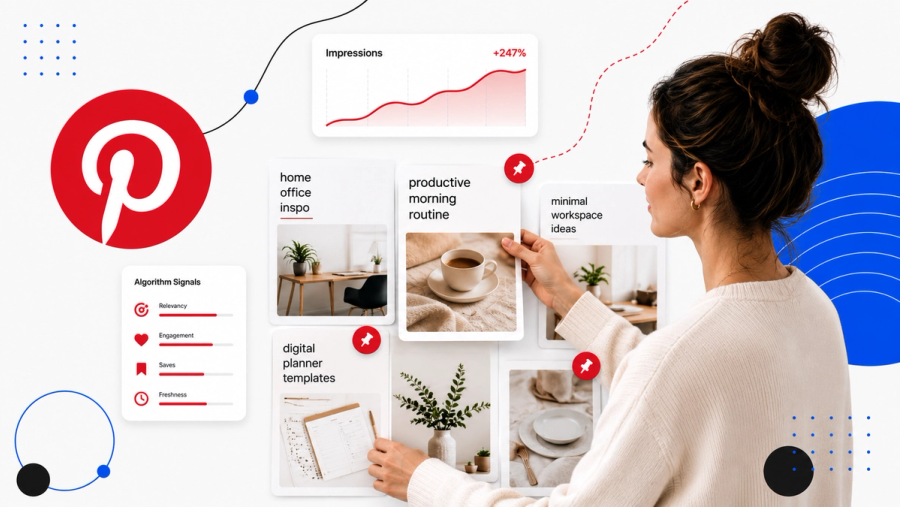
Here's something that surprised me when I started taking Pinterest seriously.
It didn't matter how many times I pinned per day — as long as what I pinned was awesome.
I could pin 5 things or 50 things. The algorithm didn't punish volume. It punished crap. It punished spam. It punished low-effort repins of things nobody cared about.
But when I was pinning things I genuinely loved — content I wanted to share, products I actually used, ideas that were helpful to other people — the reach was almost limitless.
That taught me something fundamental about algorithms that applies everywhere: they exist to keep the spam out, not to limit good content. When you're creating and sharing things that are genuinely useful to others, the algorithm is on your side.
Why Pinterest Works So Well for Affiliate Marketing
Think about what happens on other platforms. Someone sees your post on Instagram — they're in entertainment mode. They might double-tap, but they're not ready to buy anything.
On Pinterest, someone searches "best home office setup" or "meal prep for beginners" or "digital planner templates." They're already in planning mode. They're already thinking about what to buy.
And unlike a social media post that disappears from the feed in hours, a pin can drive traffic for months or even years. Some of my top-performing pins are years old and still sending clicks today. That's one of the reasons you should start building on Pinterest now — everything you create today is an investment in future traffic.
It compounds the same way blog content does. Maybe even better, because the visual format catches attention in a way that a text-based search result can't.
The Visual Search Piece Most Affiliates Miss
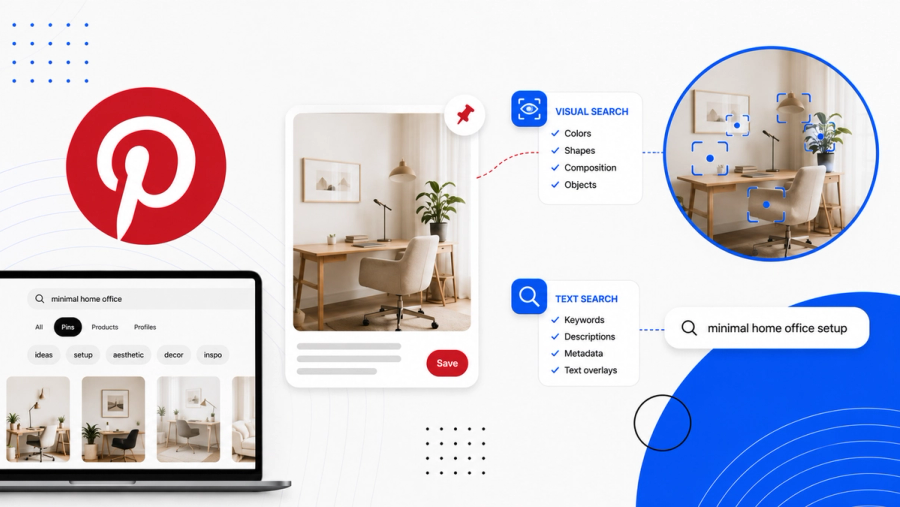
Here's where it gets interesting. Pinterest doesn't just read your pin description. It literally sees your image.
The algorithm analyzes colors, shapes, text overlays, and composition. It uses visual intelligence to connect users with relevant content — even if they didn't type in a specific search term.
Most affiliates optimize their text and ignore the visual signals. That's backwards on Pinterest. Your image needs to communicate exactly what the user is looking for.
But here's the second bite at the SEO apple: the text still matters too. The metadata, the pin description, the text overlay on the image — all of it is searchable. People are typing keywords into Pinterest the same way they type them into Google. So you need both: visuals that stop the scroll AND text that matches what people are searching for.
It's a two-layer optimization. Visual search gets your pin discovered by people browsing. Text-based search gets your pin discovered by people typing. When you nail both, your reach multiplies.
As Luigi Florimo, our Director of Affiliate Sales, puts it:
"The trick is understanding traffic sources — where are they going? That's where affiliate marketing is going to be."
Pinterest is where shopping intent lives. And most affiliates are still ignoring it.
Digital Products: The Overlooked Opportunity
When people think of Pinterest affiliate marketing, they usually think physical products — home decor, clothes, kitchen gadgets.
But the real overlooked opportunity is digital products.
Online courses, ebooks, software, templates, memberships — these are uniquely suited for Pinterest. An infographic showing the steps to start a business, a template preview, a before-and-after transformation — these visuals can inspire action just as effectively as a photo of a physical item.
This is where Digistore24 becomes your best friend as an affiliate. It's free to join. Over 8,500 products in the marketplace — many of them high-converting digital products. The cookie lasts 180 days. And they have cross-device tracking, which matters a lot on Pinterest because people often discover things on their phone and buy later on their laptop.
If someone clicks your pin today on mobile and purchases on desktop three months from now, you still get credited. That's huge for a platform where people save things and come back to them later.
The Flip Side: Got a Digital Product? List It on Digistore24.
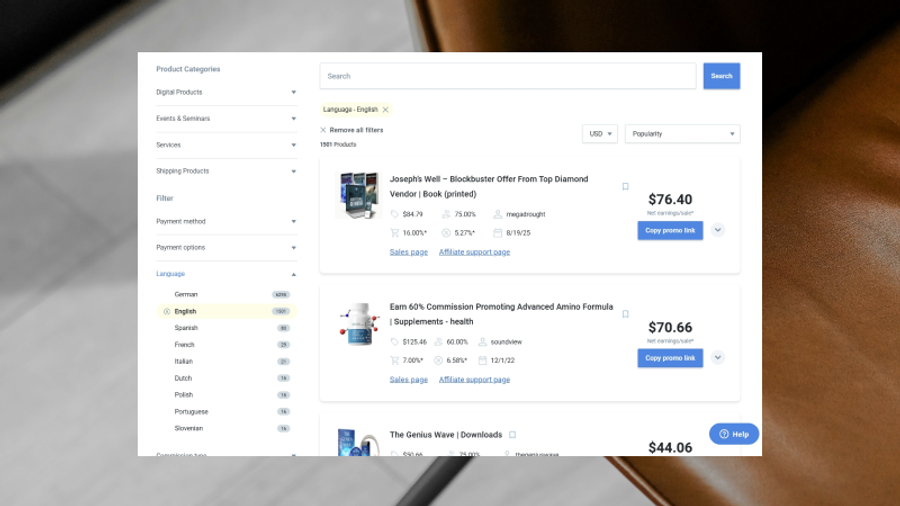
If you're on the other side of this — you've created a digital product and want affiliates promoting it for you — Pinterest makes that even more powerful.
When your product is listed on Digistore24, thousands of affiliates can find it in the marketplace and start promoting it on Pinterest (and everywhere else). You don't have to do the pinning yourself. You get an army of people creating visual content that drives traffic to your product.
Here's how fast this can happen: with Pagewheel ($47/month), you can create a complete digital product — ebook, course, lead magnet — with a professional sales page in about 34 minutes. Then push it directly into Digistore24 with one click. Your product is live in the marketplace, ready for affiliates to promote, the same day you create it.
Digistore24 handles all the payment processing, affiliate tracking, tax compliance, and payouts. You focus on creating a great product. The affiliates focus on driving traffic. Everyone gets paid.
Building Your Pinterest Affiliate Strategy
So how do you actually do this?
Start with a Pinterest business account. It gives you analytics and the ability to claim your website.
Focus on visual storytelling. Don't just post a picture of an ebook cover. Create Idea Pins, video pins, and carousel pins that solve a problem. Use compelling text overlays that make someone want to click.
Provide value first. Your content strategy should help people before it sells to them. Answer a question. Show a process. Give a tip. Then point them toward the solution.
Pin consistently — but only pin great stuff. Remember what I said earlier. Volume doesn't matter if the quality isn't there. But if you're sharing genuinely helpful content, you can pin a lot without being penalized.
Optimize for both visual AND text search. Make your images clear and compelling at thumbnail size. Then write descriptions packed with the keywords people are actually searching for.
If you have your own digital products, Pagewheel lets you create sales pages and funnels that convert. If you're an affiliate promoting other people's products, you can use it to build bridge pages that warm up the buyer before they hit the seller's page. Either way, it connects directly to Digistore24.
And if you're completely new to affiliate marketing, Rachel Miller and I co-teach Launch Pad — $10/month, and it includes a bonus bridge page builder in Pagewheel. We walk you through how to set up these systems from scratch.
Tracking What Works
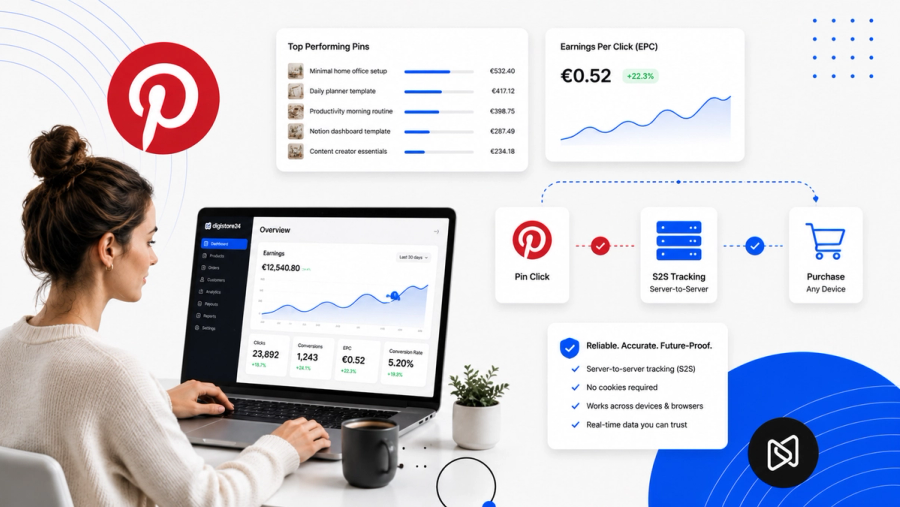
Getting clicks is only half the battle. You need to know which pins are actually driving revenue — not just vanity metrics.
Because Pinterest involves multi-touch conversions (someone sees a pin, saves it, comes back a week later, clicks through, then buys on a different device), accurate attribution is critical.
This is another reason I use Digistore24. They offer server-to-server (S2S) tracking — meaning data goes directly from one server to another, bypassing the browser. No cookies required. In a world where browsers are blocking third-party cookies left and right, this is essential.
With the real-time analytics dashboard, you can see your Earnings Per Click (EPC) and conversion rates instantly. You know exactly which products are worth promoting and which pins are driving actual sales.
The Future of Pinterest for Affiliates
Visual search is only getting smarter. Pinterest Lens already processes 1.5 billion visual search queries per month — up 40% from last year. Users can take a photo of something and instantly find similar products.
As these AI-powered features evolve, affiliates who are already creating high-quality visual content will have a massive advantage. You're building a library of searchable, discoverable assets that work for you around the clock.
"Distribution is the only moat when execution is infinite because of AI," says Nick Eubanks, Global CMO at Digistore24.
Pinterest is a distribution channel that most affiliates are sleeping on. The ones who figure it out now will be years ahead when visual search becomes the default way people shop online.
Start Simple
You don't need to overhaul your entire strategy. Start with one product you genuinely use and recommend. Create three to five pins around it — different angles, different visuals, different text overlays. See what gets traction.
The Digistore24 marketplace is free to join. Browse the digital products. Find something that solves a real problem for the audience you already have (or want to build). Get your link. Make a pin.
That's it. That's how you start.
FAQ
Is affiliate marketing allowed on Pinterest?
Yes. Pinterest allows affiliate links directly in your pins. You paste your link into the "Destination link" field when creating a pin. Just make sure you follow their community guidelines and properly disclose the affiliate relationship.
How is Pinterest different from other social media for affiliates?
Intent. People come to Pinterest to plan, research, and shop — not to be entertained. That means they're already closer to a buying decision when they see your content. Plus, pins are evergreen. A pin you create today can drive traffic for years, unlike a social media post that disappears in hours.
What types of products work best on Pinterest?
Both physical and digital products work well, but digital products (courses, templates, ebooks, software) are the overlooked opportunity. Visual content can effectively convey the value of intangible products — especially through infographics, step-by-step previews, and transformation visuals.
How many pins should I create per day?
There's no magic number. What matters is quality, not volume. You can pin 5 things or 50 things — as long as everything you pin is genuinely helpful and well-designed. The algorithm rewards quality and penalizes spam.
Do I need a large following to succeed on Pinterest?
No. Because Pinterest functions as a search engine, your content can be discovered by anyone searching for that topic — regardless of how many followers you have. Focus on creating pins that answer specific questions and solve specific problems.


