

The Grind Cycle Has a Name — And You Might Be Living in It
If you have ever caught yourself finishing one big client project, then immediately panicking about where the next one is coming from, then delivering that one and panicking again — welcome to what I call the grind cycle.
Fill the pipeline. Deliver to clients. Scramble to fill the pipeline again.
It is not a strategy. It is a trap. And the most dangerous part is that it can look like success from the outside. You are busy. Revenue is coming in. You're clearly doing something right.
But inside the cycle, you are exhausted, your systems are held together with good intentions and muscle memory, and there is never enough margin — financial or mental — to build toward something better.
I spent years helping consultants escape this cycle, and what I have found consistently is that the hidden profit was there all along. It was just buried under inefficiency, under manual tasks that should have been automated, and under marketing that was talking about the business instead of the client.
What $100,000 in Hidden Profit Actually Looks Like
When I say I help consultants find $100,000 in hidden profit, I am not talking about adding new revenue streams or hiring a sales team. I am talking about recovering value that is already being generated but leaking out through broken processes, underpriced services, and misaligned positioning.
The evidence is in the client results. One client saw a 52% year-over-year sales increase. Another hit 42% growth. Neither of them added staff. Neither of them dramatically expanded their service offerings. What they changed was how efficiently their business converted effort into revenue.
For digital product sellers and course creators, this concept translates directly. You might already be generating significant traffic and a meaningful conversion rate. But if your onboarding experience is clunky, your upsell timing is off, or your follow-up sequence ends too early, you are leaving money inside your own funnel.
The question is not "how do I get more leads?" The question is "How much of the value I am already creating is actually reaching my bottom line?"
"Maybe it would be easier to just get a job." — Rachel Minion
The Moment Every Entrepreneur Faces
That pull quote above is something I said out loud, and I meant it. There is a moment in every serious entrepreneurial journey — usually more than one — where the honest, rational calculation looks like this: I could stop fighting this, take a salary, have benefits, and stop carrying all of this alone.
I am not embarrassed by that moment. I think pretending it does not exist is one of the most damaging things entrepreneurship culture does to new business owners. The myth that "real" entrepreneurs never doubt themselves is how we produce people who suffer in silence instead of making smart decisions.
What I learned to do with that feeling is to use it as diagnostic data. When I felt the pull toward "just get a job," it was almost never because the business was failing. It was because I had not yet built the systems that would make the business feel sustainable. The feeling was pointing at the problem.
And the problem was almost always the same: I was working in the business when I needed to be working on it.
The Automation Story That Changed How I Think About Roles
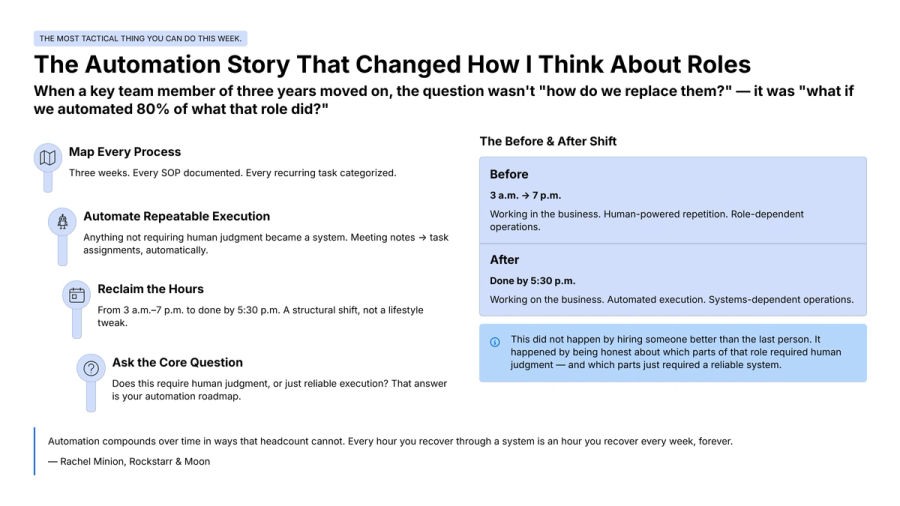
Here is the most tactical thing I share in the episode, and it is something any digital operator can implement immediately.
I had a project manager of three years who moved on. For most business owners, losing a key team member that experienced would mean months of chaos and an expensive replacement search.
My husband challenged me with a different question: what if you could automate 80% of what that role did?
Three weeks of intensive work followed. I mapped every process the project manager owned. I rewrote the SOPs. I built automations for the repetitive tasks. I replaced the meeting note-taker function with a system that automatically converts meeting transcripts into task assignments.
The result: I went from working 3 a.m. to 7 p.m. to finishing my workday by 5:30 in time for dinner.
That is not a small quality-of-life improvement. That is a structural shift in how the business runs. And it happened not by hiring someone better than the last person — but by being honest about which parts of that role required human judgment and which parts just required a reliable system.
For affiliate program managers and digital product operators on Digistore24, this exact logic applies to your own operations. How many tasks in your business repeat the same steps every time? How many of those steps require a human decision, and how many just require execution? The answer to that question is the blueprint for your automation roadmap.
Make the Client the Hero — Not Yourself
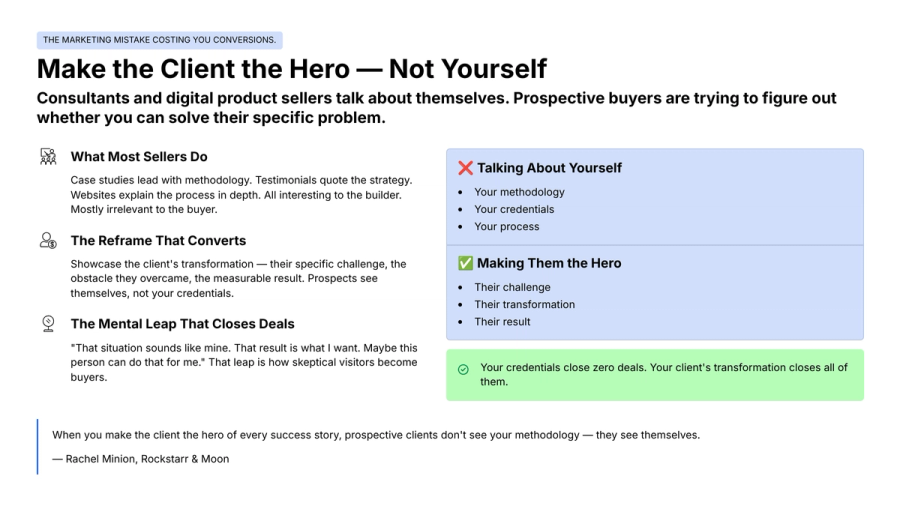
There is a marketing mistake I see constantly among consultants and digital product sellers: they talk about themselves.
Their case studies lead with their methodology. Their testimonials quote the strategy. Their website explains their process in depth.
All of that is interesting to the person who built it. It is mostly irrelevant to the prospective client who is trying to figure out whether you can solve their specific problem.
My reframe is simple: make the client the hero of every success story. When you showcase the client's transformation — their specific challenge, the obstacle they overcame, the measurable result they achieved — prospective clients do not see your methodology. They see themselves.
They think:
"That situation sounds like mine. That result is what I want. Maybe this person can do that for me."
That mental leap is how consultants, course creators, and digital product sellers convert skeptical visitors into buyers. It is not about proving your credentials. It is about making your audience feel seen in your marketing.
Practical Takeaways for Digital Product Sellers
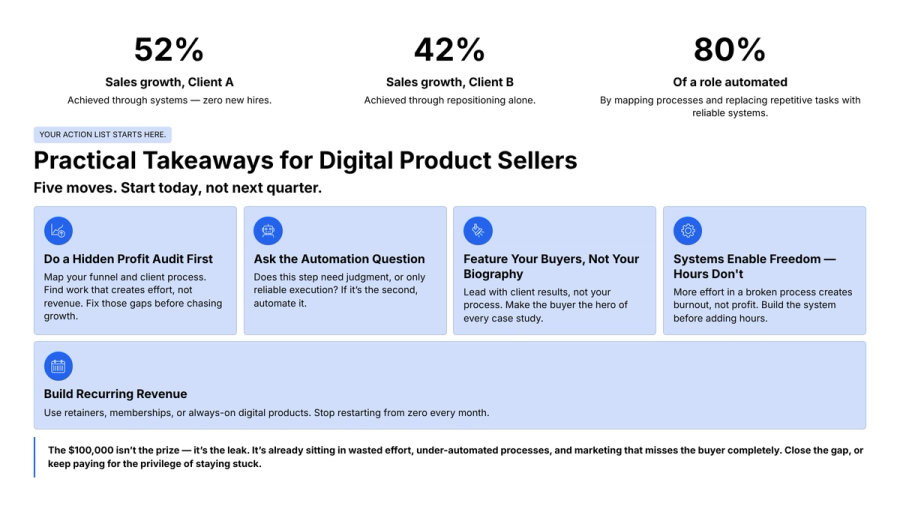
Do a hidden profit audit before you look for new revenue. Map every stage of your funnel and every client-facing process. Identify where effort is being generated without a corresponding revenue return. Fix those gaps first.
Ask the automation question about every recurring task. "Does this step require human judgment, or does it just require reliable execution?" Anything in the second category is a candidate for automation, and automation compounds over time in ways that headcount cannot.
Your marketing should feature your buyers, not your biography. Case studies that center client results convert better than case studies that center methodology. Reframe your success stories with the client as the protagonist.
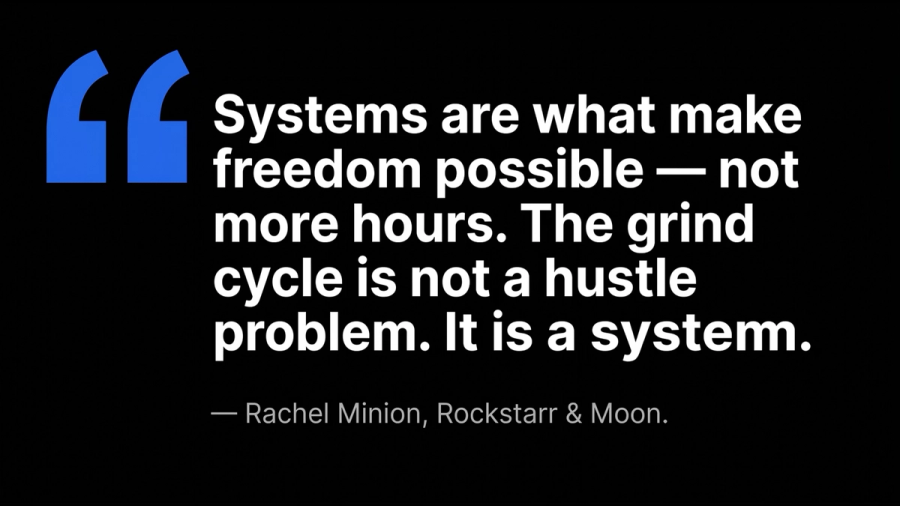
Systems are what make freedom possible — not more hours. The grind cycle is not a hustle problem. It is a systems problem. More effort inside a broken process produces more exhaustion, not more profit.
Recurring revenue changes your leverage. Whether that is a retainer structure, a membership, or a digital product with ongoing updates — building income that does not require you to restart from zero every month is the exit ramp from the grind cycle.
Build the Business That Can Grow Without Grinding
The grind cycle is compelling because it feels like progress. But forward motion inside a broken loop is not the same as forward motion toward a better destination.
What Rachel Minion's work makes clear is that the $100,000 is usually already there — in lost efficiency, in under-automated processes, in marketing that talks past the buyer. The work is not to generate more raw activity. The work is to close the gap between what the business is producing and what is actually reaching the bottom line.
For digital product sellers, course creators, and affiliate marketers building on platforms like Digistore24, the systems conversation is not optional. It is the difference between a business that scales and a business that simply grows more chaotic as it grows larger.
Listen to the full episode on Unscripted Small Business: Breaking the Consultant Hustle Cycle with Rachel Minion. To explore Rachel's Profit Multiplier program, visit rockstarrandmoon.com/profit-multiplier.
The profit is in there. You just have to know where to look.


